Behind the Pushback
I’ll admit it: most of my thinking starts as pushback.
Something bothers me. I can’t accept it. That’s not right, I think. That’s usually the moment when I find I have something to write.
This site is called an alternative — another place, standing alongside. Not opposition. Coexistence. And yet the person who chose that name is built like this.
There’s a structural problem with defining yourself against something.
A hero needs a villain. Take the villain away, and there’s nothing left to be the hero of. When your position is a reaction to someone else’s, it depends on them. If they change, your position wobbles. If they disappear, it disappears with them. You’ve handed the other side the power to decide where you stand.
And there’s a second cost. Opposition obliges you to keep watching. To keep opposing something, you have to keep observing it, keep your picture of it current. Before long, you notice you’re spending most of your time looking at things you don’t even like.
Start from pushback, write from pushback, and this is where you end up.
So I’ve made a habit of doing one thing before I write.
I turn the pushback into a choice. A thought that began as “that’s wrong” gets carried further — to “then what do I choose?” I wait until I can say it not as an argument against someone, but as the reason for something I’ve chosen.
It’s not that I don’t want to argue. But often I can’t argue well. I feel that something is off, and I can’t say what. All I have is a vague unease.
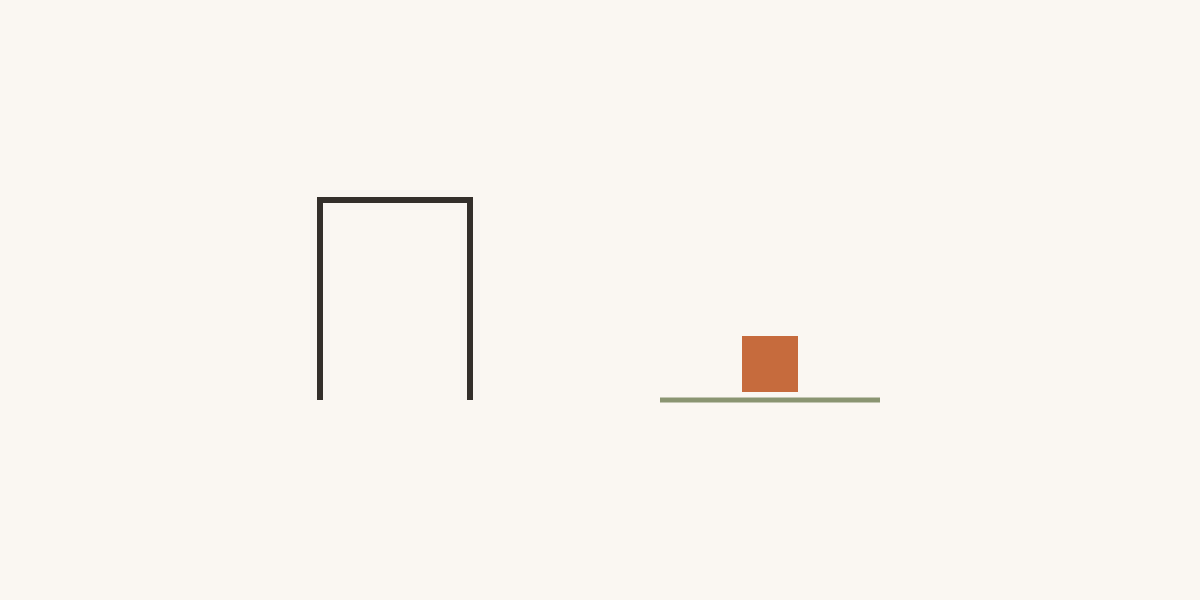
Turning it into a choice works even then. I may not be able to say what’s wrong with their position, but I can say what I choose. And more than anything: I don’t want to stand where I have to keep watching them, where they get to define me. Pushback is a doorway. Nobody has to live in a doorway.
Doing this over and over, I’ve come to see something.
Behind the pushback, there’s almost always something I care about, and it was there first. Behind my resistance to speed: time to think slowly. Behind my resistance to scale: a size I can hold in my hands.
So when I feel pushback, it’s also a signal — a chance to find out what I care about. I could write the pushback itself. But I’d rather write what’s behind it. That’s the part that stays, even after whatever I was pushing against is gone.
An alternative is the name for that kind of place.
Not the opposite of something. Next to it. A place that stays even after the villain is gone.
Someone who starts from pushback, learning to step out of its grammar. This essay is one round of that practice.